
By Lara Khneisser, founder of AïeLEAD · Confidence, purpose and intentional living · 6-minute read
What does unconditional love for children look like in everyday life? Here is how warmth, acceptance and clear boundaries can support children’s confidence, self-worth and emotional wellbeing.
The short answer
Unconditional love tells a child: “You matter to me because you are you.” It does not mean having no expectations or boundaries. It means a child’s worth, and their place in our hearts, does not depend on grades, achievements or getting everything right. Children feel it through everyday moments of listening, warmth, calm correction and repair after difficult moments.
“Will you still be proud of me?”
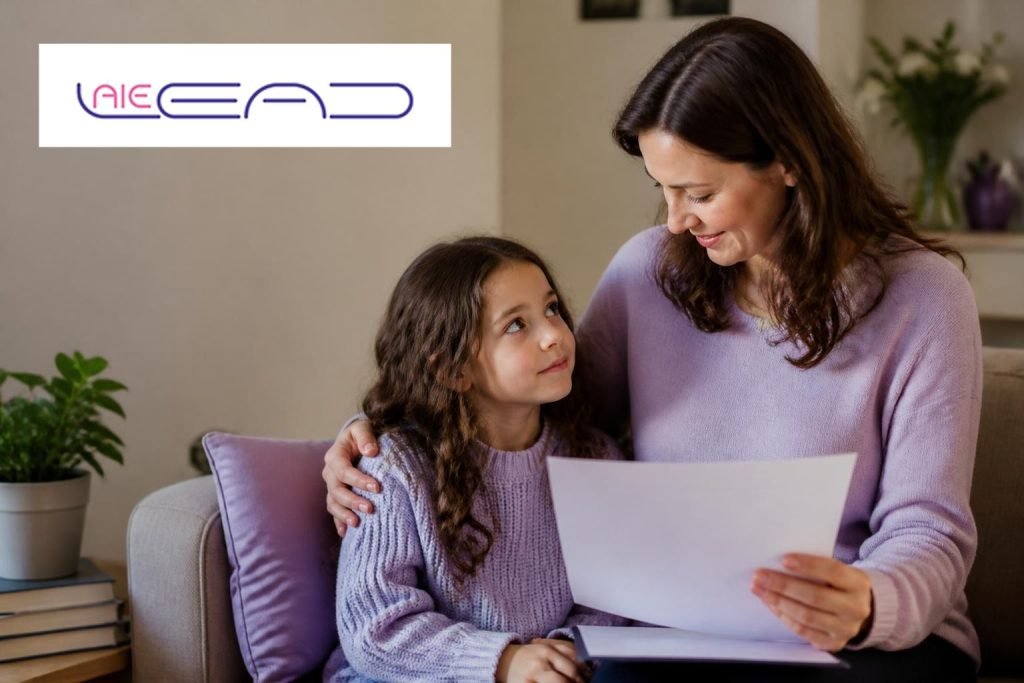
A child stands in the doorway, holding a school report. Before handing it over, she studies her parent’s face.
There are some encouraging comments. There are also areas where she has struggled.
“I tried,” she says quietly.
In that moment, she may be asking more than whether her results are good enough. Perhaps the question underneath is: “Am I still good enough for you?”
Most parents would answer without hesitation: “Of course you are.” Yet children do not always experience our love exactly as we intend it. They notice our expressions, the questions we ask first and how we respond when they disappoint us.
This is why unconditional love deserves a place in our conversations about learning, confidence and personal development. Children need guidance and encouragement. They also need to know that their place in our hearts does not depend on getting everything right.
What is unconditional love for children?
Unconditional love communicates a steady message: “You matter to me because you are you.”
A child does not have to earn that care through high marks, obedience, sporting success or an agreeable mood. We can delight in their achievements while remaining equally committed to them during disappointment, conflict and mistakes.
That might sound like:
- “I love seeing you enjoy your work.”
- “I know this result disappointed you. Let’s talk about what would help.”
- “I am upset about what happened, and I still love you.”
The distinction is between the child’s worth and the behaviour or outcome we are discussing.
There can be something to put right without there being something wrong with who the child is.
Why feeling loved matters for children’s development
Love becomes meaningful to a child through repeated experiences of care. Someone listens. Someone responds. Someone notices when they are overwhelmed and helps them find their way back.
The Center on the Developing Child at Harvard University describes responsive, back-and-forth interactions between young children and caring adults as “serve and return”. These exchanges support developing communication and social skills and help build foundations for later learning.
In everyday life, this can be wonderfully ordinary:
- A toddler points, and an adult follows their interest.
- A child shares a worry, and someone pauses to listen.
- A young person makes a mistake and discovers that an honest conversation is still possible.
These moments communicate: “My experience matters.” “I can ask for help.” “I have someone to turn to.”
They do not remove every difficulty. They offer a relationship within which difficulties can be faced.
When affection feels dependent on achievement
Imagine two responses to a disappointing test result:
“I don’t want to talk to you after a result like that.”
“This is disappointing. Let’s understand what happened and decide what to do next.”
Both express concern about the result. But the first also threatens connection.
Researchers use the term parental conditional regard to describe making approval or affection dependent on children meeting expectations. A 2004 study found associations between perceived conditional regard and experiences including fluctuating self-esteem, internal pressure and resentment towards parents. These findings help explain why obtaining the desired behaviour is not the only measure of a helpful parenting approach. They do not establish an inevitable outcome for any individual child.
We can hold high expectations while helping children feel secure in our care. For a child struggling at school, that reassurance may be especially important:
“We will work on the difficulty together. Your results do not decide how much you are loved.”
If school is a particular worry, you may also find these articles helpful: Working Hard but Still Struggling with Maths? and Why Does My Child Forget Everything?
Unconditional love includes healthy boundaries
Loving a child unconditionally does not mean agreeing to every request or accepting every action. Children need adults who will protect them, explain limits and help them take responsibility.
- “You are angry. I won’t let you hit.”
- “You can disagree with me. We still need to speak respectfully.”
- “You broke something. Let’s work out how to repair it.”
In each example, the feeling or relationship is acknowledged while the boundary remains clear. Love can be warm and firm at the same time.
The same principle matters in adult relationships. Caring about someone does not require tolerating abuse, abandoning your needs or giving them unlimited access to your life. Compassion and accountability can belong in the same conversation.
Does a lack of love explain harmful behaviour?
When someone behaves selfishly or tries to control others, it can help to wonder what fears or experiences may lie beneath their actions. But we cannot know a person’s childhood from their behaviour.
Greed, insecurity, ambition and controlling behaviour have many possible influences. They cannot all be traced to a single absence of love. Nor does a difficult childhood determine someone’s character or future.
People who experienced inconsistent care can build meaningful relationships and become thoughtful, compassionate adults. People who were deeply loved can still make harmful choices. Love matters profoundly. Human development remains complex.
A useful response combines curiosity with responsibility: “What might help me understand this person, and what boundaries are needed?”
How to show unconditional love: 6 everyday ways
You do not need elaborate activities or perfect words. Begin with small, repeatable moments.
1. Connect before asking about performance
Try: “I’m happy to see you. How are you feeling?” There will be time to discuss homework, behaviour or results. Let the welcome arrive first.
2. Notice who they are, as well as what they achieve
“I enjoyed hearing your ideas.” “That was thoughtful of you.” “I love spending time with you.” Children deserve experiences of being enjoyed without having to produce something impressive.
3. Make room for uncomfortable feelings
“You seem disappointed. Would you like to tell me about it?” Listening does not require agreeing with every interpretation or fixing the problem immediately. Sometimes a child needs to feel understood before they can consider advice.
4. Correct the action without labelling the child
Replace “You’re so careless” with: “The drink spilled. Let’s get a cloth, then find a safer place for the glass.” Specific guidance gives the child something useful to do.
5. Repair after difficult moments
Every parent and educator has moments they wish they had handled differently. “I spoke too sharply. I’m sorry. The rule still matters, and I want to explain it calmly.” An apology can preserve the boundary while taking responsibility for how it was communicated.
6. Offer affection in ways the child welcomes
Some children enjoy a hug. Others prefer sitting nearby, sharing an activity or hearing a reassuring sentence. Respecting their preferences helps care feel safe and personal.
Parents need care, too
An article about unconditional love should not become another test that parents feel they are failing.
Consistent responsiveness can be harder when adults are exhausted, isolated, unwell or under financial pressure. Harvard’s guidance recognises the importance of supporting caregivers as well as children.
- You can love your child deeply and still need a break.
- You can struggle with patience and seek support.
- You can recognise a pattern from your own childhood and begin responding differently.
The goal is a relationship in which care is dependable and mistakes can be repaired.
The love children can carry forward
Imagine that child handing over her school report again. Her parent reads it, then looks up.
“Thank you for showing me. I can see there are things to celebrate and things we need to work on. We’ll work through those together.”
The conversation may still be challenging. A plan may still be needed. But the child has heard something she can carry into the next difficult moment: “I can struggle and still belong.”
That is a powerful foundation for growing, learning and relating to others. We cannot guarantee the adults our children will become. We can give them repeated experiences of care, respect and accountability, and opportunities to practise offering those things to others.
The love we give today can become part of what they draw on tomorrow.
Supporting the whole young person
At AïeLEAD, we believe developing potential includes helping young people recognise their worth, understand themselves and build meaningful relationships. Through our Learn • Experience • Achieve • Develop framework, we support learning and personal growth alongside confidence and emotional wellbeing.
Because behind every result, ambition or difficult moment is a person who deserves to feel seen.
Would you like to talk about your child?
Start a conversation with Lara Khneisser about your young person’s learning, confidence and wellbeing.
Frequently asked questions
What does unconditional love mean for children?
It means a child knows they matter because of who they are, not because of their grades, behaviour or achievements. Parents can still hold expectations and set boundaries while making it clear their love does not change.
Does unconditional love mean no boundaries?
No. Children need adults who protect them, explain limits and help them take responsibility. Love can be warm and firm at the same time: “You are angry. I won’t let you hit.”
How can I build my child’s self-worth?
Connect before asking about performance, notice who your child is as well as what they achieve, listen to difficult feelings, correct the action rather than labelling the child, and repair after difficult moments.
What is parental conditional regard?
It is the term researchers use for making approval or affection dependent on a child meeting expectations. Research has linked it with fluctuating self-esteem and internal pressure in children.
 |
About the author Lara Khneisser is the founder of AïeLEAD. She has more than 20 years in education as a teacher, coordinator and school principal, and supports young people’s learning, confidence and personal growth. Learn more about AïeLEAD. |
References and further reading
- Center on the Developing Child at Harvard University. Serve and Return. developingchild.harvard.edu
- National Scientific Council on the Developing Child (2004). Young Children Develop in an Environment of Relationships: Working Paper No. 1.
- Assor, A., Roth, G., & Deci, E. L. (2004). The emotional costs of parents’ conditional regard: A self-determination theory analysis. Journal of Personality, 72(1), 47–88. DOI
Editorial note: The opening scene is fictional. This article offers educational reflection and practical examples, rather than an assessment of any individual child or family.