
 By Lara Khneisser, founder of AïeLEAD · 20+ years in education · 7-minute read
Is your child struggling with maths word problems, even though they understand the lesson? Here is why some children find it hard to apply what they have learned, and how developing cognitive skills may help.
Many children who understand a lesson still struggle with maths word problems because solving them relies on more than knowledge. They need to hold information in mind (working memory), spot which details matter, choose a strategy and adapt it when the question changes. When those thinking skills are still developing, more practice of the same kind may not close the gap.
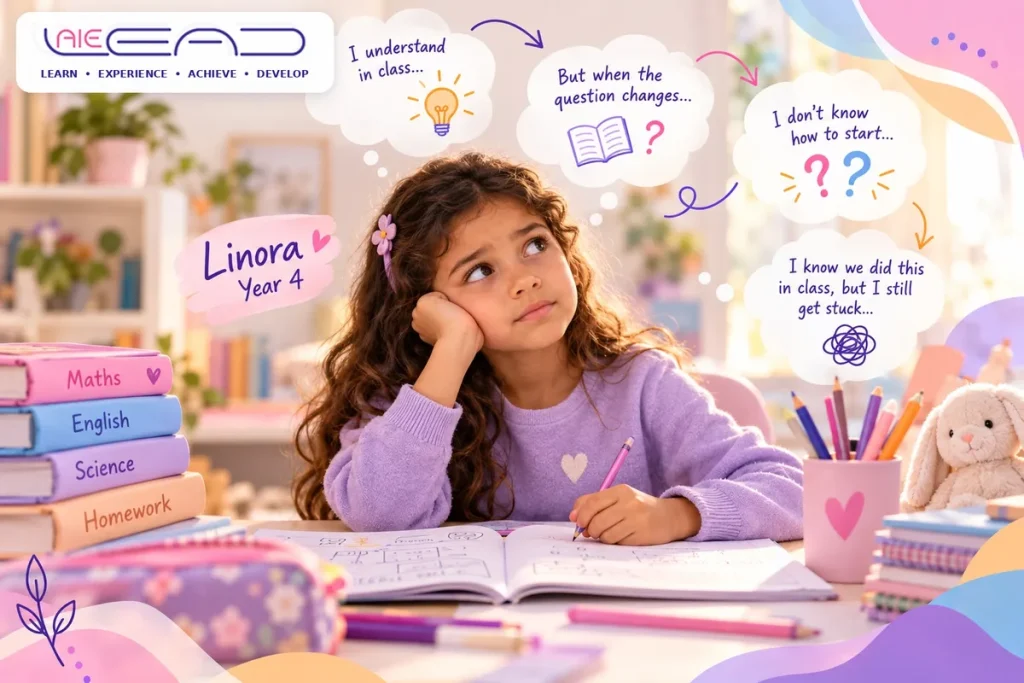
Meet Linora: the girl who does everything right
Linora is eight years old and in Year 4. She is curious, conscientious and loves making her parents proud.
Every afternoon, she comes home, has a snack and settles down to complete her homework. Her parents are supportive, her books are organised, and she rarely forgets an assignment.
At school, she listens carefully, joins in discussions and generally follows her teacher’s instructions. Of course, like any eight-year-old, she sometimes gets distracted by her friends or becomes a little mischievous!
But something continues to puzzle her parents. Despite all her effort, Linora struggles to solve problems independently.
When her teacher demonstrates a maths problem, Linora follows along. She understands the explanation and can often repeat the steps. But when the numbers change, or the same idea appears in a word problem, she freezes.
“I know we did this in class, Mummy, but I don’t know how to start.”
Sometimes she chooses the wrong operation. Other times, she understands the question but cannot work out which information matters. Her parents explain the lesson again. She practises more examples. She seems to understand. Yet the next unfamiliar question brings the same frustration.
How can a child work so hard, receive so much support and still struggle to apply what she has learned?
Why can my child do it in class but not at home?
If you are the parent of a child who is struggling at school, Linora’s experience may sound familiar. You might be wondering:
- Why can my child answer questions during a lesson but not independently?
- Why do they understand an example but struggle when the question changes?
- Why does homework take so long despite their best efforts?
- Is my child simply not trying hard enough?
The answer may have less to do with motivation and more to do with the cognitive processes involved in learning.
Learning is not simply receiving and remembering information. It also involves understanding relationships, identifying patterns, selecting relevant information, planning solutions and adapting knowledge to new situations.
For a child like Linora, the difficulty may lie in the journey between understanding something and knowing what to do with it.
A question many parents ask
In a December 2025 discussion in an online maths education forum, a parent described watching her daughter struggle with maths word problems despite tutoring, repeated explanations and long hours of homework. Single questions could take around 30 minutes, and her daughter often needed guidance again, even after working through similar examples together.
Her experience reflects an important concern: what happens when more teaching and more practice still do not lead to independent problem solving?
Linora’s story is fictional, but the frustration behind it is very real.
How working memory affects maths problem solving
Research offers important insights into why children can experience this gap.
In a 2011 study of 310 primary-school children in Grades 2–4 (roughly Years 3–5 in the UK), researchers Zheng, Swanson and Marcoulides examined the relationship between working memory and maths word-problem solving. They found that “all three WM components significantly predicted problem-solving accuracy.”
In other words, different aspects of working memory were linked to how successfully children solved maths problems.
This matters because solving a word problem requires more than knowing how to add, subtract, multiply or divide. A child must hold information in mind, understand the question, identify relationships, select a strategy and carry it through. Linora may know her times tables perfectly well, yet still struggle to decide when multiplication is the right operation.
Similarly, psychologist Adele Diamond explained in her influential 2013 review that executive functions make possible “mentally playing with ideas; taking the time to think before acting; meeting novel, unanticipated challenges.”
These abilities help children approach unfamiliar situations, adapt their thinking and work towards solutions. When a child struggles with these processes, more repetition alone may not address the whole difficulty.
What J. P. Guilford taught us about intelligence
Long before today’s discussions about cognitive development, psychologist J. P. Guilford challenged the idea that intelligence could be captured by one overall score.
His Structure of Intellect model described intellectual functioning through different combinations of mental operations, types of information and outcomes. In his 1967 framework, Guilford organised intellectual abilities into three dimensions:
- Operations: what the mind does with information, including cognition, memory, divergent thinking, convergent thinking and evaluation.
- Contents: the type of information being processed, such as words, symbols, images or behaviour.
- Products: the results of thinking, including relationships, systems, transformations and implications.
This framework offers an interesting way of looking at Linora’s struggles. She may recognise a maths rule and remember it accurately but find it harder to identify the relationship between pieces of information, or to transform what she knows into a solution.
Guilford’s work encouraged educators to consider a broader range of intellectual abilities, including those involved in creativity and problem solving. Although his original model has received significant scientific criticism and is not universally accepted as a validated account of intelligence, its educational contribution remains an important part of the history of cognitive assessment and training.
The valuable question it invites us to ask is not simply “How intelligent is this child?” but “Which thinking processes does this child find difficult, and how can we support them?”
How to help your child with problem solving: 5 ideas
For children like Linora, more worksheets may not always be the most helpful first step. Instead, parents and teachers can explore the thinking process behind the answer.
Ask how, not just what
Rather than immediately correcting a wrong answer, ask: “How did you decide what to do first?”
Make thinking visible
Use drawings, objects, number lines or diagrams to help children recognise relationships.
Change one thing at a time
Once a child understands a problem, introduce a small variation and talk about what has changed.
Encourage more than one approach
Invite children to find another way to reach the answer, building flexible thinking.
Celebrate the process
Recognise good questions, persistence and thoughtful strategies, not only correct answers.
These approaches can help you see where your child becomes stuck and support more independent learning. Persistent difficulties should also be discussed with your child’s teacher or SENCO, particularly when they affect confidence or progress.
Can cognitive skills be improved?
This is where cognitive skills development becomes especially interesting. Research suggests that certain cognitive and executive functions can improve with practice, although improvements on training tasks do not always translate into better academic results.
At AïeLEAD, we believe in exploring the abilities behind learning rather than focusing only on academic performance. Through our collaboration with Energia Wellbeing, we offer the Structure of Intellect (SOI) programme, a structured cognitive assessment and training approach inspired by Guilford’s work.
The programme aims to identify each learner’s pattern of cognitive strengths and difficulties, and to provide targeted activities to develop skills involved in:
- Comprehension and recognising relationships
- Memory and information processing
- Problem solving and reasoning
- Critical thinking and evaluation
- Creativity and flexible thinking
For a learner like Linora, the aim would be to explore the processes that make unfamiliar problems challenging, and to provide structured opportunities to practise the relevant thinking skills.
SOI has a history of use and reported positive experiences, but these should not be confused with conclusive evidence that it improves academic achievement for every child. Progress needs to be assessed individually, and cognitive training should complement effective classroom teaching and appropriate specialist support.
Helping Linora discover what she can do
Imagine Linora approaching her next maths problem. Instead of immediately saying, “I can’t do this,” she pauses. She reads the question again, draws a diagram and begins identifying what she knows.
Perhaps she still needs help. Perhaps she makes a mistake. But gradually, she starts developing a strategy for approaching unfamiliar challenges.
That is the kind of progress we want to encourage: not simply getting more answers right, but becoming a more confident, capable and independent learner.
Because sometimes, a child does not need to work harder. They need someone to understand what makes learning hard, and help them find a better way forward.
Could your child be experiencing something similar?
If your child works hard but struggles to apply what they learn, let’s talk about whether cognitive skills development could support their learning journey.
Frequently asked questions
Is my child just not trying hard enough?
Not necessarily. Many hard-working children struggle to apply what they know because problem solving draws on working memory, reasoning and flexible thinking, not just effort or knowledge.
What is working memory?
Working memory is the ability to hold information in mind while using it, such as remembering the numbers in a word problem while deciding which operation to use.
What is the SOI programme?
Structure of Intellect (SOI) is a cognitive assessment and training approach based on J. P. Guilford’s model of intelligence. It identifies a learner’s pattern of thinking strengths and offers targeted activities to develop the abilities behind learning.
When should I speak to my child’s school?
If difficulties persist or affect your child’s confidence or progress, talk to their teacher or the school’s SENCO.
Lara Khneisser is the founder of AïeLEAD. She has more than 20 years in education as a teacher, coordinator and school principal, a background in Biology and Biochemistry, and is a trained Structure of Intellect learning specialist and NGNLP practitioner. Learn more about AïeLEAD.
This article is part of our series Understanding the Learner Behind the Results, exploring the science of learning, cognitive development, memory, comprehension, problem solving and giftedness.
References and further reading
- Guilford, J. P. (1967). The Nature of Human Intelligence. McGraw-Hill.
- Guilford, J. P. (1968). Intelligence Has Three Facets. Science. PubMed
- Zheng, X., Swanson, H. L., & Marcoulides, G. A. (2011). Working Memory Components as Predictors of Children’s Mathematical Word Problem Solving. Journal of Experimental Child Psychology. PubMed
- Diamond, A. (2013). Executive Functions. Annual Review of Psychology, 64, 135–168. PMC
- American Psychological Association. Structure-of-Intellect Model. APA Dictionary of Psychology. APA
- Online maths education forum, parent discussion on word-problem difficulties despite tutoring and practice (December 2025).
Editorial note: Linora is a fictional character created to illustrate learning experiences commonly encountered by primary-school pupils. Her story does not represent an individual diagnosis or a documented SOI programme outcome. This article is for educational purposes and does not replace professional educational or developmental assessment.