
By Lara Khneisser, founder of AïeLEAD · SOI Learning Specialist · 7-minute read
Why does my child forget everything, even when they listen and try hard? Here is how memory affects learning, and practical ways to support your child’s memory, learning and confidence.
The short answer
Children who forget instructions or recent learning are often not careless. Many are trying to hold more information in mind than their working memory can comfortably manage. Giving fewer steps at a time, keeping reminders visible, and practising recall in short, spaced sessions can make remembering, and learning, more manageable.
“But I just told you…”
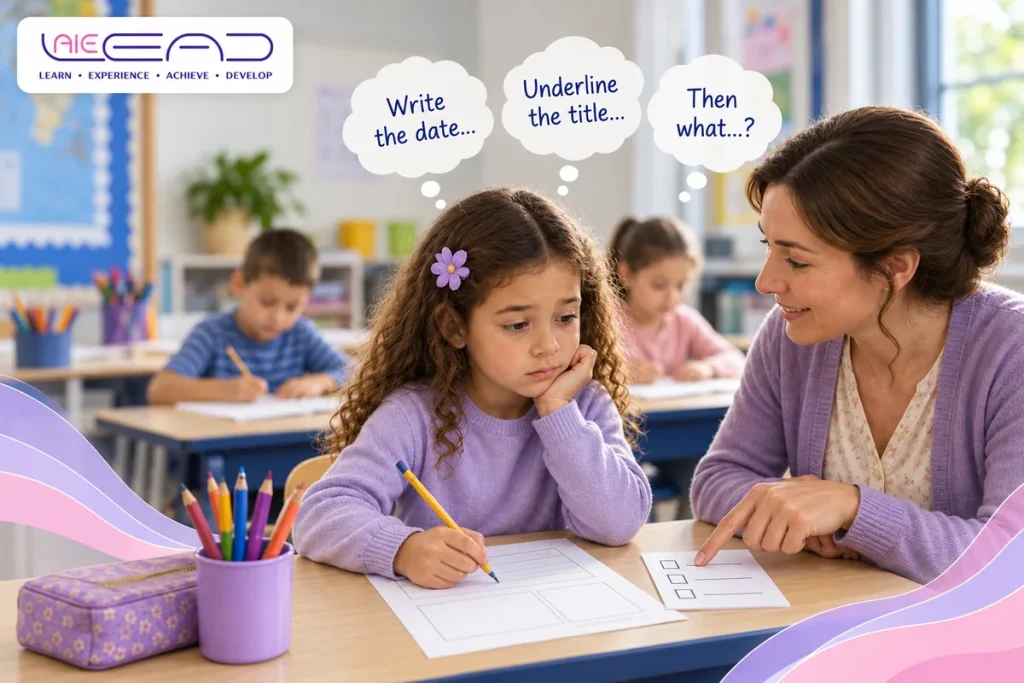
Linora puts her pencil down and looks around the classroom.
Her teacher has asked everyone to write the date, underline the title and answer the first three questions. Linora remembers something about the title. But what was she supposed to do afterwards?
She watches the child beside her, hoping to work it out.
“Linora, you need to get started.”
She lowers her eyes. She was listening. She wanted to do it properly. Yet somewhere between hearing the instructions and acting on them, part of the message slipped away.
At home, something similar happens. Yesterday, she practised her spellings and remembered nearly all of them. Today, several seem unfamiliar. During reading, she reaches the end of a paragraph but struggles to explain what happened at the beginning.
Her parents wonder: “Why does my child forget everything, even when we have just practised it?”
If this sounds familiar, you may recognise how easily concern turns into frustration, for both the adult and the child. Understanding the role of memory can help us respond with greater patience and more useful support.
Forgetting does not tell us how hard a child is trying
When a child repeatedly forgets instructions or recently learned information, it is tempting to assume they were not paying attention.
Sometimes attention does play a part. But forgetting alone cannot tell us whether a child listened, understood or made an effort. A child may be trying to hold more information in mind than they can comfortably manage.
Researchers studying classroom learning have described how children with working memory difficulties can lose track of instructions and abandon tasks when the memory demands become too great. Reducing those demands is an important part of support.
Before asking a child to try harder, it helps to ask: “What is this task requiring them to remember?”
Memory and learning: more than a filing system
Memory involves several connected processes. For parents and teachers, three useful distinctions are:
1. Short-term memory: holding information briefly
This helps a child retain something for a short time, such as a number they have just heard.
2. Working memory: holding information while using it
Think of it as a small mental workspace. A child uses it to remember the beginning of a sentence while reading the end, or to keep track of numbers while calculating an answer.
3. Long-term memory: retaining knowledge over time
This includes vocabulary, familiar facts and learned skills that children draw on during new learning.
These processes work together. A difficulty remembering something may arise when information is first taken in, while it is being used, or when the child tries to retrieve it later.
That is why “poor memory” is a starting point for understanding a difficulty, rather than a complete explanation.
How working memory problems in children can affect school life
Memory demands are woven into ordinary classroom activities, so difficulties can appear in several different ways.
When a child can’t follow instructions
“Put your reading book away, collect your science folder and turn to the next clean page.” An adult hears one straightforward request. A child has to retain several actions, complete them in order and resist interruptions.
Linora might put her book away successfully, then forget what comes next. A short instruction, followed by the next step when she is ready, may help her take part more independently.
When homework takes hours
A child starts a calculation, forgets an intermediate answer and begins again. They return to the question repeatedly because they cannot keep all its details in mind while working. What looks like slow progress may involve a great deal of invisible effort.
If maths word problems are a particular struggle, you may also find our article Working Hard but Still Struggling with Maths? helpful.
When reading and writing become demanding
Reading requires children to connect ideas across words and sentences. Writing asks them to hold an idea in mind while also managing spelling, handwriting and punctuation.
Memory can contribute to difficulties with these tasks. However, reading errors, omitted letters or spelling difficulties should not automatically be put down to memory. Language knowledge, decoding skills, attention and other learning needs may also need investigating. The aim is to understand the child’s particular difficulty, rather than give every struggle the same explanation.
When confidence begins to suffer
Repeated reminders can gradually change how a child sees themselves:
- “I always forget.”
- “Everyone else can do it.”
- “I’m just not clever.”
For a child struggling at school, being understood can make an important emotional difference. We can recognise the difficulty without turning it into an identity.
“You lost track of the steps. Let’s find a way to keep them where you can see them.”
How to improve my child’s memory: 6 practical ways to help
There are two useful goals: helping children remember what they learn, and reducing how much they must hold in mind at once. Both matter.
1. Give fewer instructions at a time
Offer one or two clear steps, then check understanding warmly: “What will you do first?” This tells you more than “Do you understand?”, which can easily receive an automatic “yes”.
2. Put reminders outside the child’s head
Use a short checklist, a worked example, pictures or a number line. A visible reminder lets children return to the task without repeatedly asking an adult. Classroom guidance on working memory recommends simple instructions and external memory aids to reduce overload.
3. Practise remembering, as well as rereading
After reading a short section together, close the book and ask: “What are two things you remember?” Keep it encouraging and low pressure, offering clues when needed. Retrieval practice helps children bring learning back to mind, rather than only recognise it on the page.
4. Spread practice across several days
A few minutes of review on different days can be more useful than one long session. A major review of learning techniques identified practice testing and spaced practice as particularly useful across a range of learners. For Linora, this might mean revisiting a few spellings today, tomorrow and later in the week.
5. Connect new learning to something meaningful
Discuss an example, draw a simple picture or ask your child to explain an idea in their own words. The purpose is to help them understand what they are trying to remember; a colourful page alone cannot guarantee learning.
6. Notice what helps
Does your child manage better when instructions are written down? When the room is quieter? When the task is shorter? Share these observations with their teacher to build a clearer picture of the support your child needs.
Can memory be trained? What about brain training for kids?
Children can learn strategies that help them remember, and practice can improve performance on particular memory tasks.
However, improving at a memory exercise does not automatically mean better reading, stronger mathematical understanding or higher school results. A substantial research review found improvements on working memory measures after training, but no convincing evidence of broader benefits to reading, arithmetic or intelligence when compared with active control activities.
This distinction matters when considering brain training for kids. Games can be enjoyable ways to practise remembering rules or sequences, but their value should be judged by what they help the child do, with progress checked beyond the game itself.
Useful goals might include starting homework with fewer reminders, following a familiar routine, or remembering taught vocabulary over time.
Exploring cognitive skills training for children
At AïeLEAD, we look beyond the finished worksheet to explore the learner’s experience.
Through our collaboration with Energia Wellbeing, we offer the Structure of Intellect (SOI) programme, a structured cognitive assessment and training approach inspired by J. P. Guilford’s work. As a certified SOI Learning Specialist, Lara Khneisser helps families explore patterns of strengths and difficulties and identify opportunities to practise relevant cognitive skills.
For a child like Linora, the conversation might begin with the situations in which remembering becomes difficult, and what meaningful progress would look like in everyday learning.
Research about memory and learning helps inform that conversation. It should not be presented as proof that SOI will improve every child’s academic performance. Progress needs to be reviewed individually, alongside classroom teaching and any appropriate specialist support. If difficulties persist or affect confidence and progress, speak with your child’s teacher or SENCO about further assessment and support.
Helping Linora remember, and feel understood
Imagine Linora receiving tomorrow’s classroom instructions. This time, the teacher gives her two steps. A small checklist sits beside her book. She completes the first action, checks the reminder and moves on.
At home, spelling practice becomes shorter and more spaced out. Her parents notice which words she remembers independently and which need another explanation.
There will still be forgotten instructions and difficult afternoons. But Linora now has tools to help, and adults who recognise her effort.
A child who forgets needs support that makes remembering and learning more manageable. Sometimes progress begins with a simple change in our response: “Let’s work out what will help you remember.”
Could your child benefit from more support?
If your child works hard but struggles to remember instructions or retain learning, AïeLEAD welcomes a conversation about their needs.
Frequently asked questions
Why does my child forget everything, even after practising?
Often because the task asks them to hold more information in mind than their working memory can comfortably manage. Fewer steps at a time, visible reminders and short, spaced practice usually help.
Does forgetting mean my child isn’t trying?
No. Forgetting alone cannot tell us whether a child listened or made an effort. Many children who forget are working very hard to keep up.
What is working memory?
Working memory is the ability to hold information in mind while using it, such as remembering the steps of an instruction while carrying them out.
Can brain training games improve my child’s memory?
They can improve performance on similar memory tasks, but research has not found convincing evidence that this alone improves reading, maths or school results. Judge any programme by changes in everyday learning.
When should I speak to my child’s school?
If memory difficulties persist or affect your child’s confidence or progress, talk to their teacher or the school’s SENCO about further assessment and support.
About the author
Lara Khneisser is the founder of AïeLEAD. She has more than 20 years in education as a teacher, coordinator and school principal, a background in Biology and Biochemistry, and is a certified Structure of Intellect Learning Specialist and NGNLP practitioner. Learn more about AïeLEAD.
This article is part of our series Understanding the Learner Behind the Results, exploring memory, comprehension, problem solving and the experiences behind school performance. Read the previous article: Working Hard but Still Struggling with Maths?
References and further reading
- Gathercole, S. E., & Alloway, T. P. (2008). Working Memory and Learning: A Practical Guide for Teachers. SAGE.
- Dunlosky, J., Rawson, K. A., Marsh, E. J., Nathan, M. J., & Willingham, D. T. (2013). Improving students’ learning with effective learning techniques. Psychological Science in the Public Interest, 14(1), 4–58. DOI
- Melby-Lervåg, M., Redick, T. S., & Hulme, C. (2016). Working memory training does not improve performance on measures of intelligence or other measures of “far transfer”. Perspectives on Psychological Science, 11(4), 512–534. DOI
Editorial note: Linora is a fictional character illustrating possible learning experiences. Her story is not a diagnosis or a documented SOI programme outcome. This article provides educational information and does not replace individual assessment.